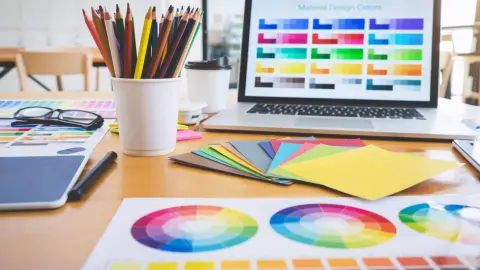
BA (Hons) Graphic and Media Design integrates a range of skills with creative concepts and interdisciplinary practice embedded in communication design. You'll develop the confidence to explore and question a broad range of design opportunities, including those arising from emerging technologies and diverse directions of design.
You’ll gain skills for practice-based and research learning so you can make meaningful contributions to the local and global landscape of contemporary design practice.
We’re committed to acknowledging the rich diversity within the cohort and recognise the importance of embracing this as a catalyst for growth, learning and collaboration. You'll have opportunities to engage in collaborative projects that not only broaden your horizons but also equip you with crucial skills in teamwork and intercultural communication.
We'll support you to produce independent and collaborative work across a range of media, so that you graduate ready to work in graphic and media design.
Our new building
You will be one of the first students to join us in our cutting-edge new building for London College of Communication, just across the road from our current site in Elephant & Castle.
Key Information for 2026 entry applicants
- From September 2026 to June 2027 you will study at our existing building.
- For your next two years of your degree you will study at our new building.
Why choose this course at London College of Communication
- Established: One of the first graphic design courses in the world, you’ll join a tradition of graphic designers who have led in the field.
- Reach your potential: In the National Student Survey 2025, 91% of students agreed the course challenged them to achieve their best work.
- Flexible and personalised study: You’ll develop core design skills while shaping your own learning path with support from specialist tutors and technicians. Current study areas include editorial, typography, generative, interaction, motion, photography, social design, 3D design, critical design, data visualisation and design research.
- Industry engagement: The course invites industry partners, including our graduates, to lead live briefs and workshops, portfolio and Q&A sessions. You’ll gain insights into contemporary industry practices and benefit from invaluable networking opportunities. Recent collaborators and clients include Nonsense creative agency, Studio Above and Below, Influx Press, GF Smith and Grenfell Athletic.
- Employability: Our graduates stand out as highly sought-after professionals due to their creativity and innovation, adaptability, technical proficiency, research skills, critical thinking and strong communication skills. This unique combination will position you as highly employable, well-prepared to excel in diverse roles.
- Reputation: UAL is ranked 7th in the UK for Graphic Design by the Guardian University Guide 2026.
- Future-readiness: In the National Student Survey 2025, 85% of students agreed that the course had developed the knowledge and skills they need for their futures.
- Design School community: You’ll join our vibrant community and collaborate on projects to develop your professional practice and make a positive impact. You’ll leave with the capacity to tackle pressing injustices in the face of the climate emergency.


 TREINTAYCINCO MM

 DEUSTO FORMACION

 GADE ESCUELA SUPERIOR
 ESDESIGN ESCUELA SUPERIOR DE DISEÑO DE BARCELONA